

For centuries, caravans crossed the deserts, mountains, and steppes of Central Asia.
Along routes that became known as the Silk Road, merchants carried silk, spices, metals, technologies, religions, and ideas between distant civilizations.
These routes linked China and Europe, India and Russia, settled cities and nomadic peoples.
Travelers often imagine the Silk Road as a single road stretching across Asia. In reality, it was a vast network, connecting cultures that might otherwise never have met.
Today, the caravans are gone. Yet the legacy of the Silk Road remains visible in magnificent architecture, ancient traditions, bustling markets, and the lives of the people who continue to call Central Asia home.
Our journey follows that legacy across Uzbekistan, Kazakhstan, and Kyrgyzstan in search of a simple question: What remains of the Silk Road after the caravans have disappeared?
Tashkent

Our journey begins in Tashkent, the capital of Uzbekistan. At first glance, Tashkent feels thoroughly modern. Wide boulevards, new construction, and busy transportation networks define much of the city.

Yet beneath its modern appearance lies a history shaped by centuries of cultural exchange. The Silk Road transported more than goods. It carried knowledge. At the Museum of Applied Arts, traditions that once supplied merchants and travelers continue to survive. Ceramics, weaving, metalwork, and miniature painting reflect skills passed from one generation to the next. These artisans preserve techniques that have endured through conquest, revolution, and modernization.
The State Museum of History reveals another side of the story. Few regions have experienced as many cultural influences as Central Asia. Buddhist artifacts sit alongside Islamic treasures. Ancient textiles share space with modern expressions of national identity. Each civilization left something behind.
Rather than replacing one another, these influences became layers in a shared cultural landscape. That same blending of old and new appears throughout modern Uzbekistan.
Samarkand

If one city symbolizes the golden age of the Silk Road, it is Samarkand. For centuries, merchants, diplomats, scholars, and pilgrims traveled thousands of miles to reach this city. Its wealth and importance grew from its position at the center of international trade.
The rise of Samarkand is closely tied to one man.
Amir Timur. Known in the West as Tamerlane, Timur built an empire that stretched across much of Asia. His conquests brought immense wealth to Samarkand, transforming it into one of the world's most celebrated cities.
His final resting place, the Gur-e Amir Mausoleum, remains one of Central Asia's architectural masterpieces. The magnificent blue dome and intricate tilework established artistic traditions that would influence generations of builders.
Those traditions reached their peak at Registan Square. Few places better capture the ambition of Silk Road civilization. The square served as a center of education, politics, and public life. Students came here to study theology, science, mathematics, and philosophy.
The buildings surrounding the plaza demonstrate not only remarkable craftsmanship but also a belief that learning itself was worthy of monumental architecture. The pursuit of knowledge reached beyond earth and into the heavens.
The Silk Road carried ideas as effectively as it carried merchandise. Perhaps nowhere is the artistic achievement of Samarkand more visible than Shah-i-Zinda.
For centuries, families commissioned increasingly elaborate tombs to honor loved ones and religious figures. The result is a breathtaking collection of tilework, color, and design. Walking through these passageways feels less like visiting a cemetery and more like entering a gallery of architectural art.
The city still lives through its markets. At Siyob Bazaar, commerce continues in much the same spirit that made Samarkand famous centuries ago. Trade remains central to the city's identity.
Bukhara
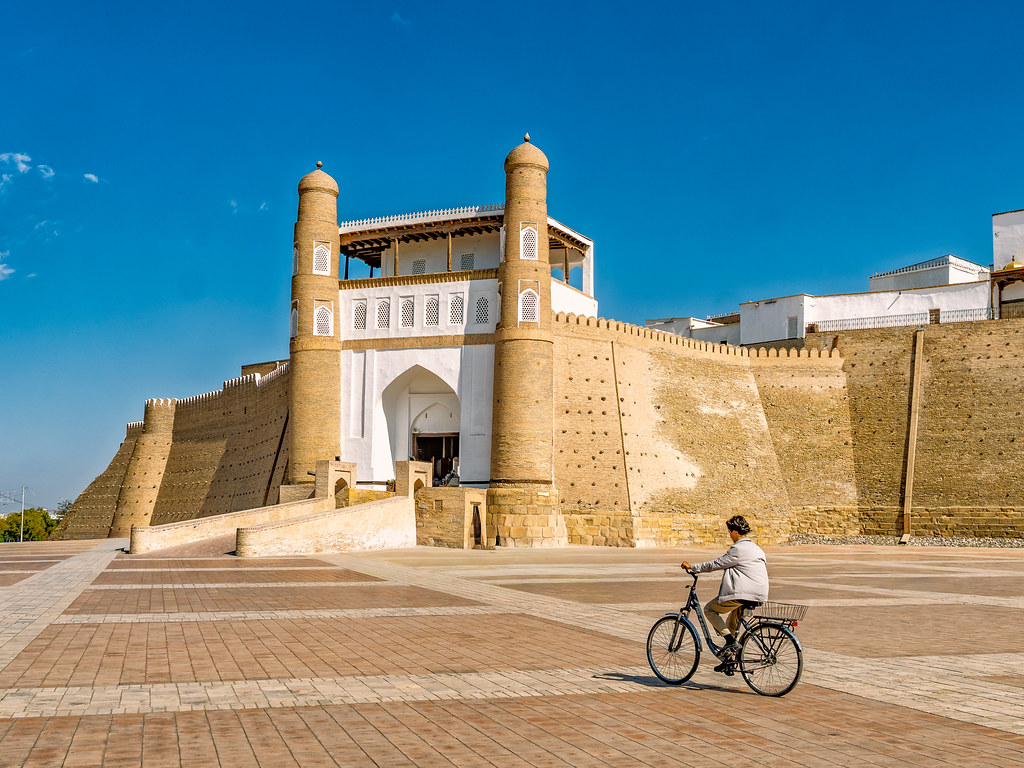
If Samarkand represents glory, Bukhara represents continuity.
For more than a thousand years, merchants, artisans, scholars, and travelers have gathered here. Empires rose and fell. Bukhara endured.
The Ark Fortress served as the seat of government for generations of rulers. Behind its walls, decisions were made that shaped the lives of people across the region.
Nearby, the Po-i-Kalyan complex reflects Bukhara's long-standing role as a center of Islamic scholarship. Its mosque, madrasa, and towering minaret stand as reminders that religion and education were deeply connected throughout much of the city's history.
Khiva

Rising from the desert, Khiva appears almost untouched by time. Encircled by massive defensive walls, it is one of the best-preserved historic cities in Central Asia. For generations, Khiva occupied a strategic position on the Silk Road.
Its merchants prospered from trade, while its rulers sought to protect their wealth behind formidable defenses. By the nineteenth century, Central Asia found itself caught between competing empires. Russia expanded southward. Britain watched closely from India. This rivalry became known as the Great Game.
Khiva stood on the frontier of that geopolitical struggle. Yet despite political change, much of the city's architectural heritage survives.
Nomads

The Silk Road depended on cities.
But it also depended on the vast lands between them.
For centuries, nomadic peoples traveled across mountains and grasslands, connecting distant settlements and cultures. Their influence remains visible throughout Central Asia.
One of the most recognizable traditions is eagle hunting. The partnership between hunter and bird requires patience, skill, and trust. What was once a practical means of survival has become a powerful symbol of cultural identity.
Long before organized sports reached the steppe, Uzbek shepherds entertained themselves with Chillik, a simple but highly skilled game played with two pieces of wood. Players launch a small peg into the air and strike it with a longer stick, sending it soaring across the landscape. Passed from generation to generation, the game remains a living link to the rural traditions of Central Asia.
Nomad Games celebrate the heritage of the peoples who once dominated the Eurasian steppe. Competitors demonstrate skills rooted in horsemanship, hunting, endurance, and cooperation. Many events originated as practical activities necessary for life in challenging environments.
To modern audiences they appear as sport. To participants they represent cultural continuity.
The World Nomad Games remind us that history is not only preserved in buildings and artifacts. It is also carried forward by people. While many ancient traditions have disappeared elsewhere, they continue to evolve here, connecting present generations with their ancestors.